By Brianna Wallen
News Editor
An unexpected discovery on Instagram transformed one family’s forgotten history into a meaningful moment of remembrance at the university.
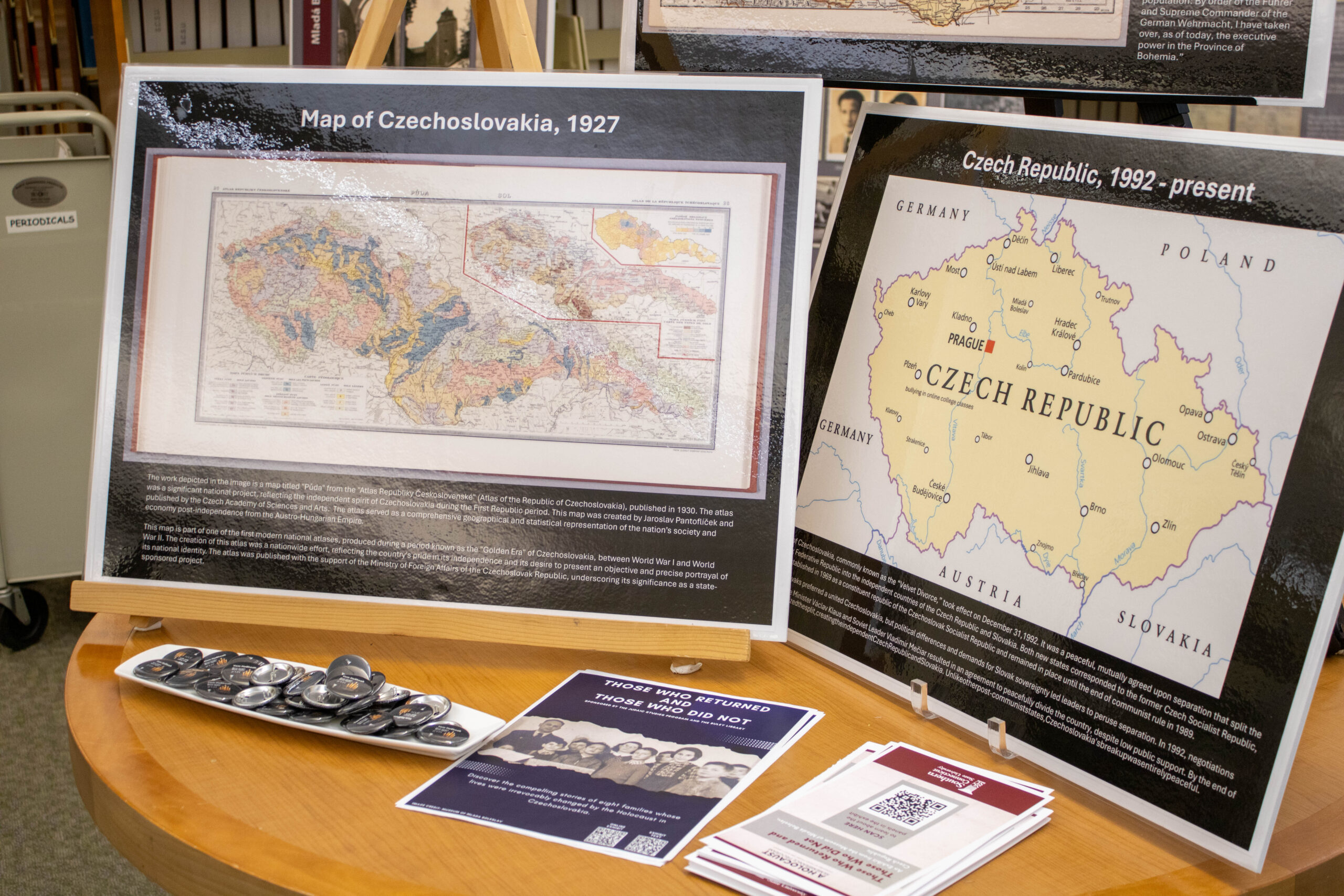
On April 15, the university opened Those Who Returned and Those Who Did Not in Buley Library, a Holocaust exhibit honoring stories of survival, loss and resilience across generations.
“I wish she could have been there. I think she would have been very pleased to see this,” Deborah Weiss, communication disorders professor emerita, said.
The exhibit, created by the Museum of Mladá Boleslav in the Czech Republic, reveals the stories of eight Jewish families deported during World War II.
It was organized in honor of Yom Hashoah, Holocaust Remembrance Day, which also marks the anniversary of the Warsaw Ghetto Uprising. O
ne of the most moving stories featured in the exhibit follows Weiss’s mother, Milada Günsburgová.
She was born in Czechoslovakia in 1921 and spent her early years in a normal and steady childhood.
“She had a brother, her two parents, and they lived a comfortable life,” Weiss said.
That sense of normalcy was quickly disrupted as Nazi rule spread across the country. Jewish families began losing their jobs, and many were forced from their homes.
Education was taken away, and everyday safety disappeared as restrictions increased throughout the region.
“She was one day ready to graduate high school, and all of a sudden, she had to get married in order to get out of the country,” Weiss said.
At just 17 years old, Milada entered an arranged marriage to an American citizen so she could escape. She later arrived in the United States in 1941 and reunited with her husband in Bridgeport, Connecticut.
“My mother didn’t want to leave her own mother behind, but my grandmother insisted that she go,” Weiss said. “She said that she had to be with her husband, and that there was no life for her in her home country anymore, and that she needed to leave.”
Milada became the sole survivor of her immediate family.
“My mother never found out until after the war what happened to her mother. She always thought that she would be able to go back after the war and live with her family there,” Weiss said.
Her father died after being beaten by the Gestapo, her brother was killed while serving in the Czech Resistance Army, and her mother was later sent to Auschwitz-Birkenau and murdered.
“Then she discovered that her brother had also been killed, and then she kind of realized that she couldn’t go back, that there was really nothing to go back for,” Weis said.
Despite losing nearly everything, Milada built a new life in America. Weiss said her mother worked hard, raised three children and valued education above all else.
“She was a very optimistic person. She was funny and witty. She cracked jokes all the time,” Weiss said.
Milada lived to be 99 and a half years old, remaining independent almost until the end of her life.
Weiss said her mother’s strength is one reason she wanted students to experience the exhibit.
“Here’s someone who is probably a little bit younger than they are right now who’s going through all of this,” Weiss said.
Weiss hopes students understand both the human cost of the Holocaust and the importance of remembering history. S
he said six million Jews were murdered, along with many other vulnerable demographics targeted by the Nazi regime.
“It’s something that can never happen again,” Weiss said. “History is really important because it shows us what people are capable of doing and why it’s important to remember and make sure that it doesn’t happen again.”
What began as a casual social media interaction eventually led to the creation of a Holocaust remembrance exhibit on campus.
“My niece Carly follows someone on social media who is a tour guide in the Czech Republic,” Weiss said. “Carly noticed that this woman had posted that she was visiting in Mladá Boleslav, and Carly said, ‘That’s where my grandmother was born.’”
After seeing Carly’s message, the tour guide responded, asking for Milada’s name. Weiss said her niece shared the family name, unaware of the surprise that would come next.
“She wrote back and said, ‘I can’t believe it. Right at this moment, I am at a museum in Mladá Boleslav, and I am looking at your mother’s picture in an exhibit,’” Weiss said.
Weiss said her message stunned her family, as they were not aware that Milada’s story had been preserved overseas.
She said that seeing photographs and her family’s history displayed in another country was both emotional and unexpected.
“We were really shocked,” Weiss said. “Like, why is our family in an exhibit in Boleslav?”
That surprise led Weiss to contact museum curator Sylva Mistecka, who explained that she had created the exhibit to mark the 80th anniversary of the end of World War II.
The exhibit highlighted eight Jewish families from the town who were sent to the ghetto, with at least one survivor from each family.
“She had heard my mother’s story in the Steven Spielberg archives,” Weiss said. “She thought it was kind of like a romance novel almost, the way that my parents met.”
From there, the idea of bringing the exhibit to campus quickly came to life. Weiss partnered with the Judaic Studies Department and Buley Library to translate and recreate the panels for students and visitors.
“It was really very much just by chance,” Weiss said. “If my niece hadn’t written to her, we wouldn’t have known about it, and we wouldn’t have brought it here.”
Weiss encourages students, faculty and community members to take time to visit the exhibit and engage with the stories it preserves.
She hopes visitors pause, reflect and connect with the history shared across each panel.
The exhibit will remain open through May 22 on the lower level of Buley Library, inviting the campus community to experience these stories of memory, loss and survival firsthand.