By Brianna Wallen
News Editor
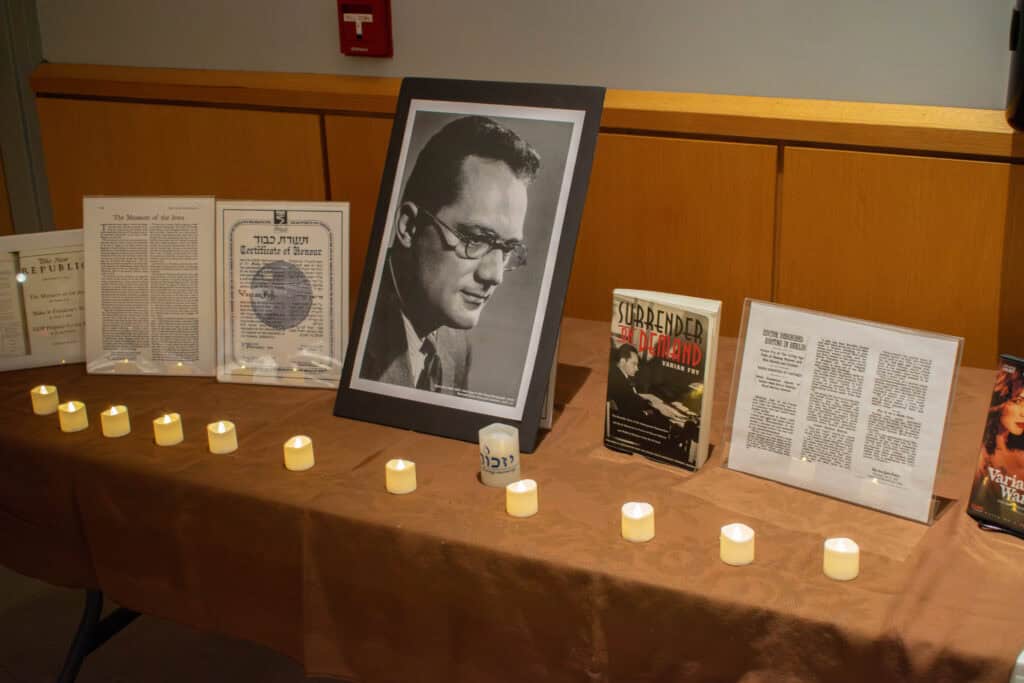
Candle lights honoring American journalist and the first American honored as “Righteous Among the Nations” by Yad Vashem, Varian Fry, in Englemen Hall on April 30. The table features Fry’s literary pieces.
As the flame of a memorial candle flickered, the community gathered in quiet reflection to remember the children who passed through the Theresienstadt (Terezín) Camp Ghetto between 1942 and 1944 and to honor all the Jewish lives lost during the Holocaust.
Six Yahrzeit candles were lit, each symbolizing a story of its own.
“Let us light six candles, one for each of the million lives lost,” Miriam Glenn, a co-host of the event and former student said.
The yellow candles symbolized the Jewish community, echoing the yellow Star of David Jews were forced to wear to mark their identity.
The Holocaust Remembrance Program, held on April 30 and following Yom HaShoah or Holocaust Remembrance Day, which was observed this year on April 24.
The program featured moving readings and prayers led by Professor David Pettigrew, Glenn, students and faculty.
Hosted by the philosophy department and the judaic studies program, the event offered a powerful space for reflection and remembrance of the six million lives lost.
David Pettigrew, a professor at the university, quoted writer and political activist, Elie Wiesel.
“I think it’s important to remember the victims,” Pettigrew said. “Forgetting the victims of the Holocaust would be like killing them a second time.”
He emphasized the importance of honoring their memory, not only as an act of remembrance but as a commitment to ensuring such atrocities are never repeated.
“This kind of remembrance program was a matter of justice and that we remember what happened and try to dedicate ourselves to preventing it from happening again,” Pettigrew said.
Pettigrew, who teaches JST 204: Introduction to Holocaust and Genocide Studies, said that it is important to student to know about the details of what transpired during the Holocaust beyond this event.
Psychology major Christopher Pardy, a junior and a student in Pettigrew’s class, read moving speeches at the event. Pardy said the class provided him deep insight into the trauma inflicted by the Holocaust and the importance of preserving its history.
“I’m learning about how precious life is and to move forward, we have to love each other and kind of come to a common ground,” Pardy said.
Masters of Science in environmental studies graduate student Stephen Cooper, said that he is grateful to see the next generation pick up the torch. Especially, because Cooper has a connection to the genocide.
“It’s nice to see the young people care about this issue,” Cooper said. “I was born a few years after the Holocaust and know adult survivors.”
Glenn, who has been co-hosting the ceremony since 2017, emphasized the importance of educating others about the experiences of children in the Theresienstadt (Terezín) Camp Ghetto.
“To show what happened to a lot children who lived in that concentration camp,” Glenn said. “Children wrote stories and pictures. Children came and left until there were only 100 left.”
The ceremony also included a tribute to Varian Fry, the first American honored as “Righteous Among the Nations,” by Yad Vashem.
According to Holocaust Encyclopedia, Varian Mackey Fry was an American journalist who established and operated a rescue network in Vichy France from August 1940-September 1941.
His efforts helped approximately 2,000 anti-Nazi and Jewish refugees, primarily artists and intellectuals, escape the persecution of Nazi Germany during World War II.
“It was challenging and dangerous work, but for the most part, he’s been completely forgotten,” Pettigrew said. “He died in Connecticut in 1967 while teaching at Joel Barlow High School.”
Pettigrew said that he wrote to the Chief of Staff of the Speaker of the House to recognize Fry in the state.
“I think he deserves to have some kind of memorial in the state of Connecticut,” Pettigrew said.
Ultimately, both Pettigrew and Glenn are proud of the community that came together to remember those lost.
Viewing it as the lighting of a candle, with each individual’s presence adding to the collective light that honors the memory of the victims.
“We’re part of a learning community that’s remembering and it’s important that we’re collaborating,” Pettigrew said. “It’s a meaningful enactment, of our community, recognizing and remembering the victims, organizing against the repetition of such crimes.”