This story was a collaboration between Professor Gil’s Journalism 220 Class by students Mackenzie Byerlee, Draven Dabrowski, Aminata Diakite, Rachel Rose, Valentina Toro and Catherine Vu. Collin Moffitt from Connecticut State Community College Manchester, contributed reporting to this story.
When college students think about mental health resources, they might picture counseling centers, crisis lines or therapy appointments. But one of the most powerful tools against suicide might not be found in a clinic— it might start with a simple conversation.
College campuses throughout Connecticut are training students to recognize warning signs, ask direct questions and connect someone in crisis to professional help. The training — called Question, Persuade, Refer — aims to give students the confidence to be part of the statewide response to increased suicide rates.
“You don’t have to be a counselor or therapist to help someone,” Wellbeing Specialist Erin Duff, who leads the QPR training at the university, said. “You just have to be willing to pay attention and step in when something feels off.”
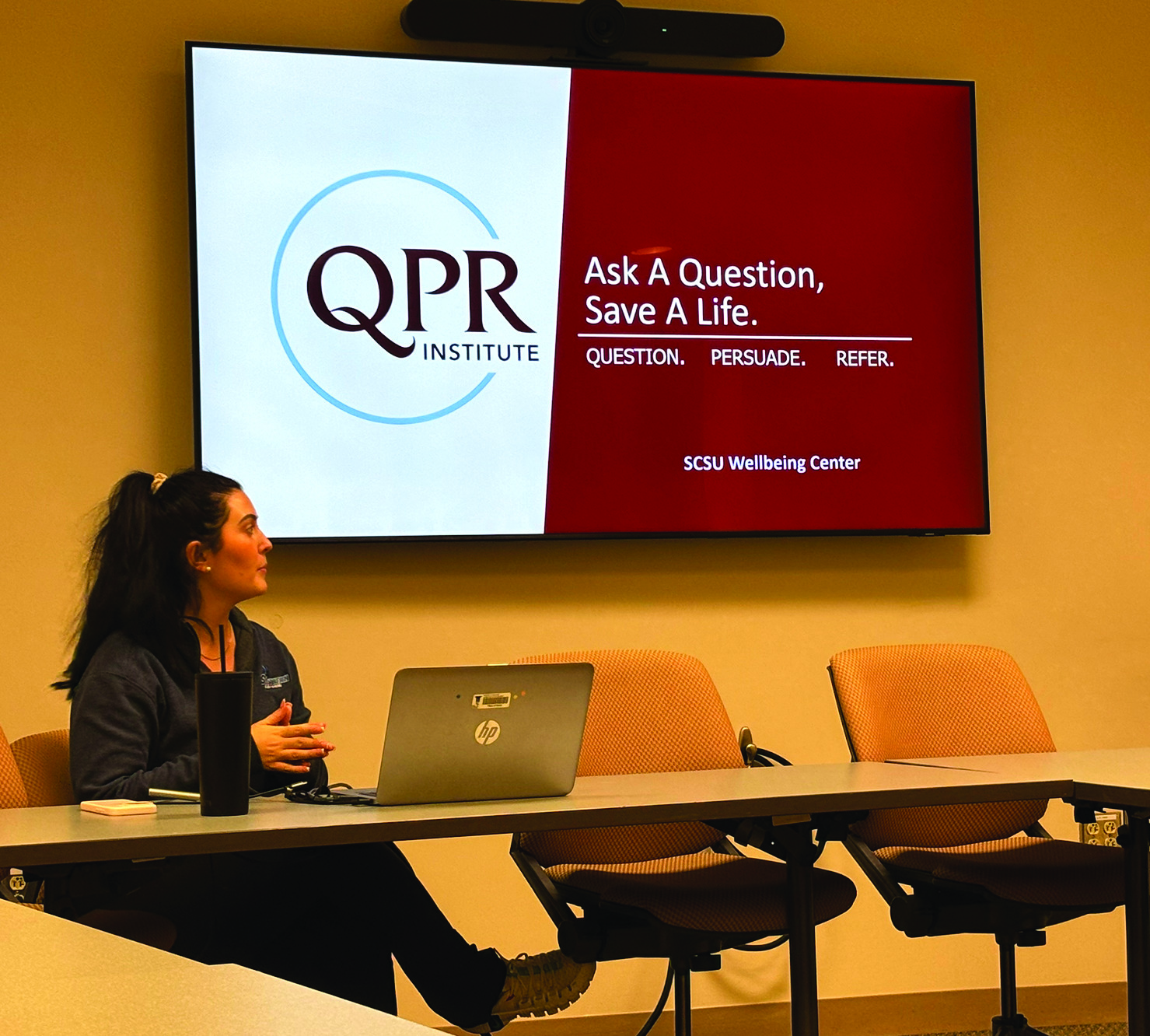
On an early November morning, Duff and nine students sat around a table in a conference room in the Adanti Student Center.
Duff said the part everyone hesitates about is asking the question: “Are you thinking about suicide?”
Duff outlined that the direct question, feel like they are crossing an invisible line.
These 90-minute sessions teach participants how to spot warning signs, ask direct questions and refer someone to help. During a separate session led by Wellbeing Coordinator Allyson Regis, participants practiced how to respond in real-life situations.
The university has been hosting the training since 2022. In the 2024-25 school year, a total of 345 students and staff attended the training.
Suicide remains a serious and persistent public health concern in Connecticut and beyond.
Over the past three decades, the state has seen a gradual but noticeable increase in suicide deaths across the state.
Between 2019 and 2023, the state averaged roughly 370-400 suicide deaths per year compared to about 100 homicides each year.
While deaths among young adults aged 20-24 have declined as a percentage of total suicides, the age group still represents nearly 6% of statewide suicides, at 23 deaths in 2024.
Men account for roughly three-quarters of all suicide deaths; middleaged and older men remain the most at risk.
Suicide prevention has long been a focus in Connecticut, with targeted youth initiatives dating back to the 1980s.
Now, a statewide approach that reaches all age groups, the Connecticut Suicide Advisory Board, brings together hundreds of agencies for monthly prevention and planning efforts.
The state’s latest Suicide Prevention Plan, among other efforts, calls for stronger coordination around campus trainings and programs.
Connecticut’s prevention network also includes programs like Fresh Check Day, an interactive fair promoting mental health awareness through peer engagement.
Fresh Check Day, founded in 2012 by the Jordan Porco Foundation and now managed by Connecticut Children’s Medical Center, aims to normalize mental health discussions.
“The program is designed to be flexible and adaptable so each campus can shape it to meet its specific needs,” Program Outreach Coordinator Isabella Baldino said.
Several Connecticut colleges, including University of Connecticut and the state community college system, host Fresh Check days each year.
“FCD is not titled a suicide prevention fair, otherwise students wouldn’t likely attend,” Hyman said. “Better to market it as a mental health and suicide prevention and resources fair.”
The fair features booths, food and interactive displays, including one where students wrote affirmations like, “I am shy, but I am not weak.”
“All booths at the event have messaging embedded that speak to suicide prevention,” Hyman said.
Other programs include UConn HELPS, a training that covers common myths, warning signs and key resources, and Programs On-The-Go, a wellness initiative at CCSU that sends guest speakers to deliver presentations about mental health.
Biology major Jadelyn Garcia Medina, a junior who serves as a peer mentor coordinator and orientation ambassador, said the QPR training is a great way to better understand how to support others.
“The training is a good reminder to stay openminded and to be kind to everyone. You never know what someone is going through, and learning different ways to support students can make a real difference,” Garcia Medina said.
Brian Quinnett, the executive director of the QPR Institute, described the training as intentional and very straightforward.
“You recognize someone in a mental health crisis, start a conversation and help get them to professional care,” Quinnett said.
Quinnett revealed that the true impact is hard to count because “lives saved” cannot be tracked perfectly. The strategy is simple: train as many people as possible so help is nearby when someone needs it.
“You need to train thousands to save one and millions to save thousands,” Quinnett said. “The more people we train, the more lives we believe are being saved.”