By Victoria Cruz
News Writer
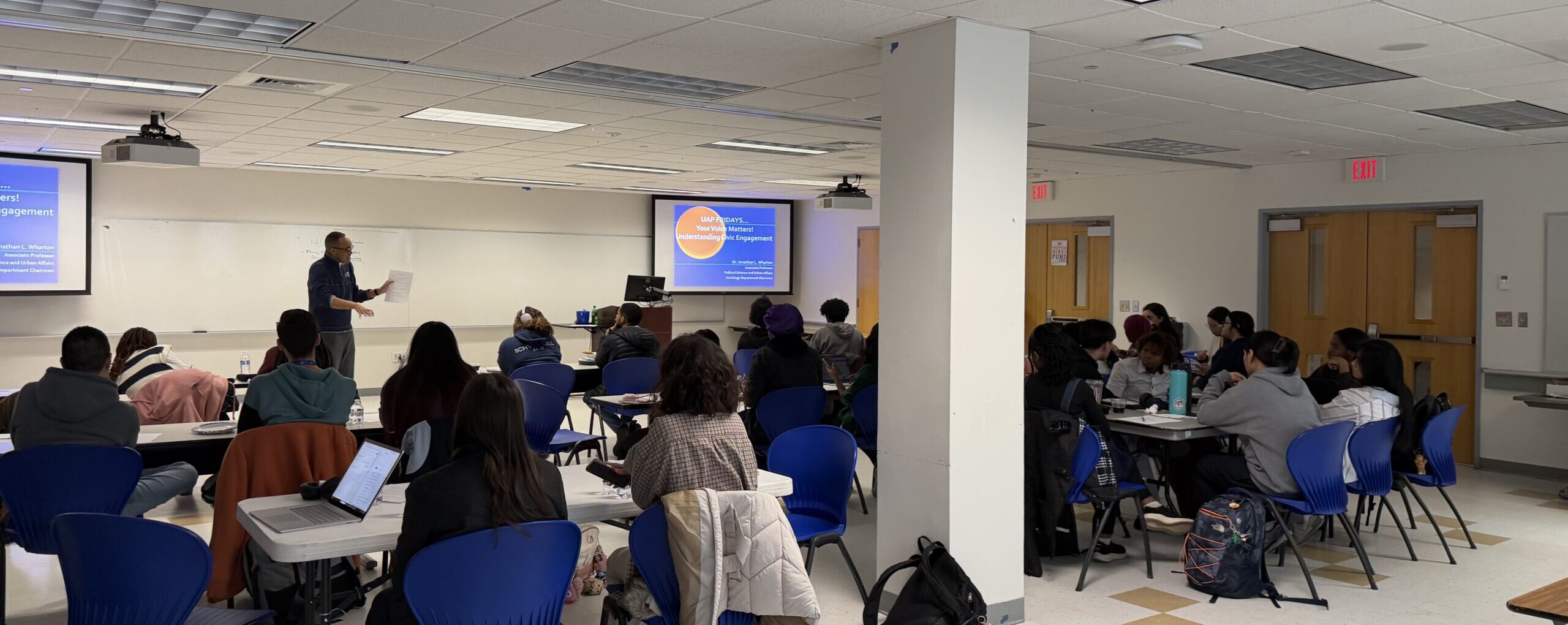
On Friday, March 27, the University Access Program hosted another installment of UAP Fridays with a Purpose titled Civic Engagement: Because Your Voice Matters In Your Career and Community.
Presented by Jonathan L. Wharton, associate professor in the political science and urban affairs department and sociology department chairman, the event opened with an interactive survey designed to engage students and encourage reflection from the start.
“I am not very familiar with this topic, and it is not talked about much. I want to learn what civic engagement is all about and learn how I can be involved in my community,” nursing major Maria Gonzalez, a sophomore, said.
The conversation began with introducing the concept of political socialization, prompting attendees to think about social networks that have shaped their civic awareness.
While civic engagement often begins at an early age, it tends to decline during college years, as students become focused on academics and other responsibilities.
Discussion then shifted to patterns of civic participation, particularly among younger voters. Data shared during the event revealed that voter turnout for individuals aged 18-30 is significantly lower than older generations.
According to this data, only 38% of young people participated in presidential elections and closer to 18% in local elections. In contrast, older populations can reach turnout levels of up to 60%. Only half of the students in attendance reported that they had voted.
Within Connecticut, towns such as Glastonbury, Wethersfield and West Hartford reported some of the highest voter participation rates, often correlating with higher levels of home ownership and education.
Meanwhile, cities like Bridgeport, Hartford and New Haven tend to experience lower turnout, particularly within Black and Latino communities.
A key takeaway from the discussion was that many students feel they lack the capacity or knowledge to engage in civic life.
Wharton emphasized that civic engagement requires intentional effort and action as well as an understanding of why participation is necessary.
Attendees discussed practical ways to become more engaged, including attending city meetings, writing testimonies, volunteering, campaigning and participating in demonstrations.
Students were also encouraged to engage in conversation with others, even when they are unsure of their own opinions.
By asking questions and understanding different perspectives, individuals can become more informed and take meaningful steps toward participation.
In Connecticut, where unaffiliated voters cannot participate in party primaries, students discussed the implications of political affiliation.
This became a topic of discussion because more young voters choose to remain independent in a system where many elections are effectively decided during primaries.
Ultimately, the event emphasized that civic engagement begins with awareness but requires action and intention.
“It’s important for a population to have political efficacy and know that their vote and contribution to their community counts. It’s important to learn ways you can practice that,” Gonzalez said.
Students were encouraged to stay informed, participate in both their hometowns and in New Haven and build communities that support civic involvement.
“I should be more involved in my local town and with things that are happening, and I don’t pay attention enough. Knowing how easy it is to start makes it feel easier,” graphic design major Johanna Sampedro, a junior, said.
Knowledge is only valuable when it is actively used, and students have more power than they may realize to create change within the communities they are a part of.