By Brianna Wallen
News Editor
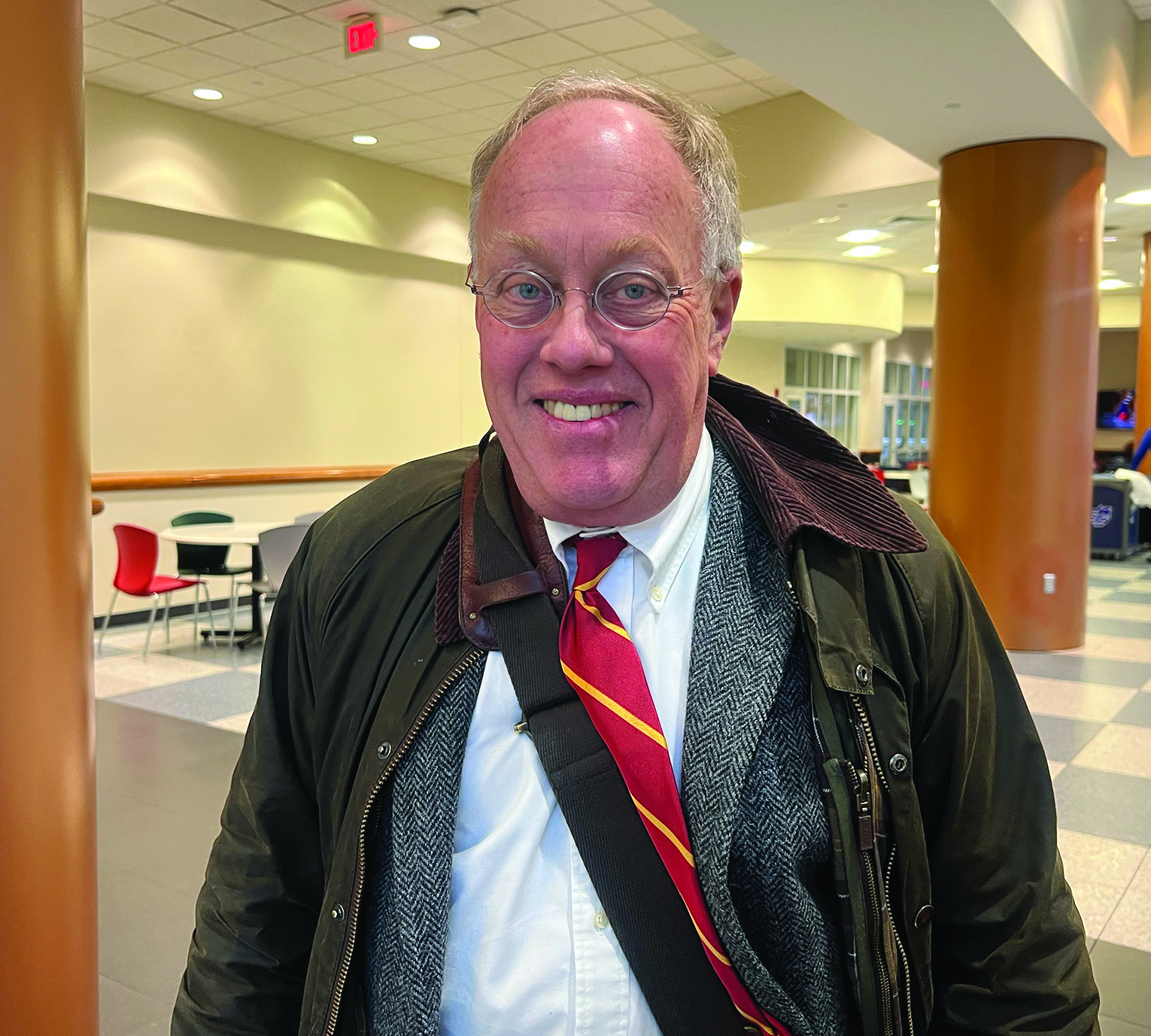
The university welcomed Pulitzer Prize-winning journalist, author and activist Chris Hedges on Thursday, March 5 to deliver his moving lecture, The World After Gaza.
Known for his decades of reporting from conflict zones in Central America, the Middle East and the Balkans as well as his criticism of global power structures, Hedges spoke to students and community members about the broader political and humanitarian consequences of the war in Gaza.
“These tools of control, the wholesale surveillance, the drones, the sensors under the ground, all that stuff which has been used on the Palestinians is now showing up along the border of the United States to stop Mexicans and showing up in places like Lesbos and Greece to block the migrants coming in from North Africa,” Hedges said.
Hedges set the stage for audience members by emphasizing that the conflict in Gaza should not be viewed as an isolated tragedy. He explained that the systems used in the conflict are already coming into play, as they are affecting policies and security measures in other parts of the world.
Hedges tied these developments to the growing climate crisis and ultimately, a mass migration.
“As the climate breaks down, as you have larger and larger numbers of people fleeing devastated ecosystems in the Global South, all of the mechanisms to build what in essence will become climate fortresses are evidenced in the subjugation of the Palestinians,” Hedges said.
Hedges placed the conflict in a broader historical context by stating that violence and mass migration have been long-standing elements of colonial systems of power.
“Genocide is at the core of Western imperialism,” Hedges said. “We are a genocidal nation. The Americas, whether through Europeans or Euro-Americans or the Spanish, was one big genocide.”
Hedges outlined that the patterns of violence inflicted on Palestinians echo past atrocities in the Global South. He pointed out that in 1943, during the Bengal famine, about three million Indians died mainly because the British took control of the region’s grain supplies.
According to Hedges, Winston Churchill dismissed any responsibility for the disaster and instead referred to Hindus as “a beastly people with a beastly religion.”
Whether it is famines, forced labor or colonial repression, Hedges noted that these acts of violence and control have a pattern of being silenced or minimized by those in power.
“These kinds of genocides or holocausts were not new if you came from the Global South, but they were not acknowledged by the perpetrators,” Hedges said.
Hedges argued that the same patterns of oppression seen in the past continue to shape conflicts and crises around the world today.
Hedges closed his lecture with a warning about the rise of authoritarian practices in the United States by drawing parallels between Immigration and Customs Enforcement and other forces abroad.
“The next five years, I see fascist violence is already on the streets of America,” Hedges said. “ICE, now has more funding than any other federal law enforcement agency.”
Hedges pointed out that ICE’s increasing power is not exclusively asserted to combat immigration enforcement.
“If you think these massive warehouses — and if you’ve seen the plans for them, like these individual cells where they can cram 10,000 people — and if you think they’re for undocumented people, you’re very naive,” Hedges said.
Hedges drew on his own experiences in Iran, Chile and El Salvador to describe how these kinds of state forces act without accountability. Hedges said he still recalls the exact moment he seen this happen firsthand.
“I have seen these movements, whether it’s the Basij in Iran, and I was thrown in a jail cell by them,” Hedges said.
Hedges stressed that these state-controlled forces like ICE are fostering a rogue vigilante force that operates outside the law. “They are usurping the work of police departments, and not just Minneapolis, but citie
s across the country. They are actually weakening the police departments by creating a climate of fear,” Hedges said.
By instilling fear in residents, Hedges said these forces undermine community trust and discourage people from coming forward.
“You shred community solidarity and community assistance, so people don’t want or they’re too scared to report,” Hedges said. “So, the violence already here in this country has been eviscerated,” Hedges said.
Apart from this warning, Hedges emphasized the power of nonviolent action by urging the audience to take collective action through solidarity, civil disobedience and organized activism.
“Violence in any society will produce counter-violence,” Hedges said. “It’s the collective nonviolent ability to shut the system down that’s our only hope.”