By: Lily Dalton
Contributor
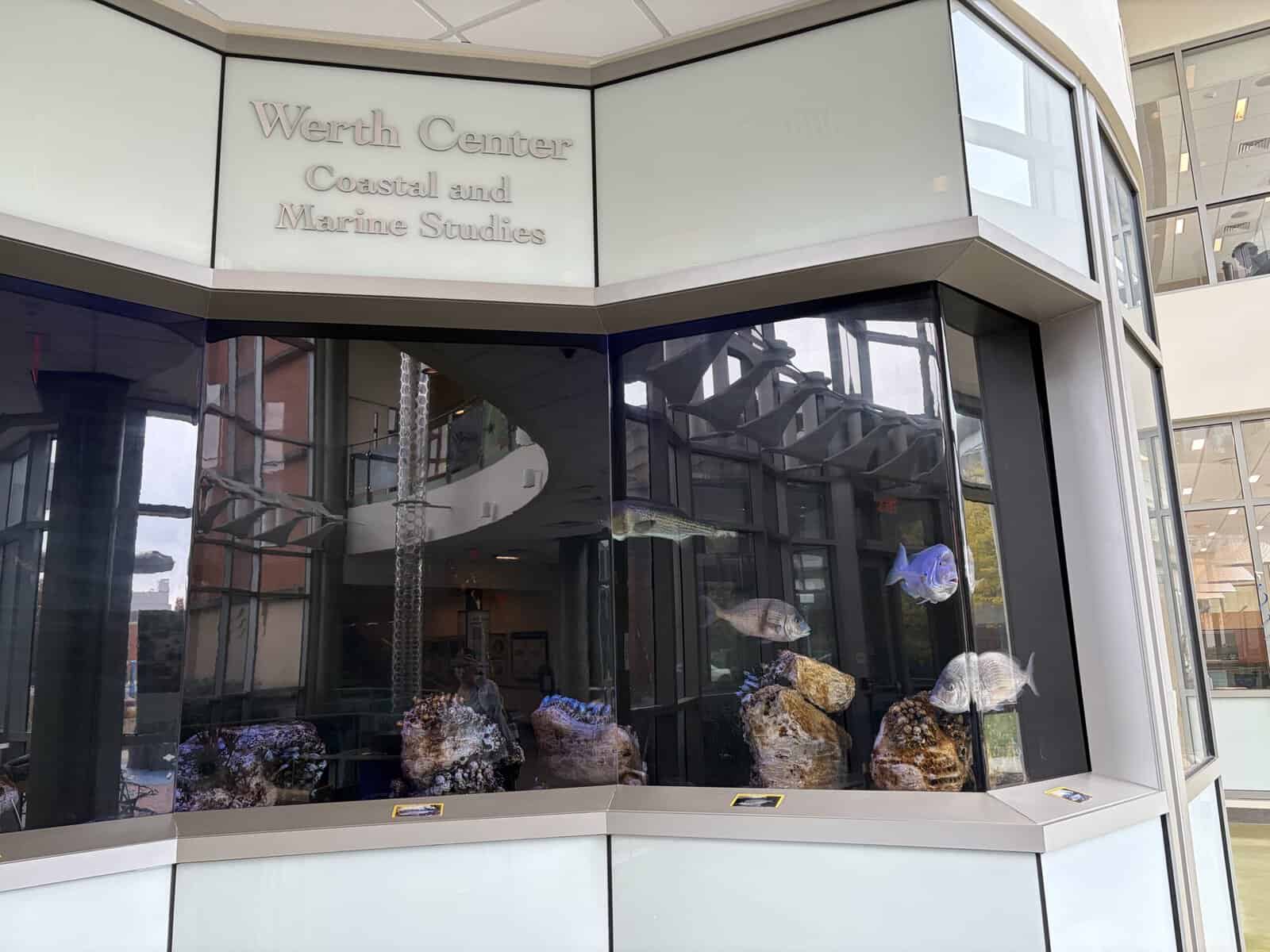
With the Long Island Sound just a short drive from the university, the department of Environment, Geography and Marine Sciences has brought aquaculture even closer to student life through its own aquariums in the Academic Science and Laboratory Building.
Built in 2015, the aquariums serve as educational tools for various students while also offering an interactive experience for the university community, aiming to bring a little joy to those who pass by.
“The aquariums bring people lots of joy. When you’re just walking from one classroom to another, it’s great to see all of the fish swimming around,” Emma Cross, associate professor of coastal and marine science and co-director of the Werth Center for Coastal Marine Studies, said.
The aquariums are managed by the Werth Center, a Connecticut system-wide center housed at the university.
“We have private donors from the Werth family who provide funding for us to really boost our marine science education here at Southern,” Cross said.
The funding supports two display tanks on the first floor of the science building, one featuring a pier piling enclosure and the other recreating a seafloor-like environment.
“Additionally, we have two touch tanks inside the aquarium downstairs,” Cross said. “One of them has lots of invertebrates, and the other we have a couple of horseshoe crabs in.”
The touch tanks are designed to encourage interaction and are primarily used to educate visiting school groups and tours about marine life.
With several tanks on campus, maintaining the aquariums requires daily attention to the health of marine life and the environment they occupy.
“There are four of us, and we are all in charge of feeding, taking care of the fish in case of infection, water quality tests, weekend checks on the smaller tanks used for MAR 210,” environmental and marine science major and Werth Center fellow Maryorie Hernandez, a senior, said.
The fellows help maintain the aquariums here on campus while also participating in hands-on fieldwork and data collection at Long Wharf to expand their knowledge and experience.
“The degree that I am in is hands-on,” Hernandez said. “The lecture part has its place, but it’s definitely completely different when you’re out in the field, learning it, then just sitting in a classroom seeing a professor press through slides.”
While the aquariums offer hands-on learning opportunities for marine science students, beyond the classroom, they also serve as a point of interest for students passing through the building.
“I think it is an absolutely fascinating thing, and it definitely opens the eyes of a lot of other students to all of the other possibilities that we have in this kind of school,” psychology major Gabriel Rubio, a freshman, said.
The aquariums catch the eye of many students just passing by; many make the quick stop part of their routine.
“I stop to look at the fish all the time when passing by,” physics major Leah Leffingwell, a junior, said.
Whether it is to educate future marine scientists or simply to bring a smile to the campus community in passing, the Werth Center aquariums are a reminder of the marine life that exists just beyond the university.
“I hope the aquarium breaks up the mundane class schedule in students’ days and also inspires them to think about the marine life they have on their doorstep and how their daily lives are also impacting Long Island Sound,” Cross said.